Showing posts with label academic libraries. Show all posts

Tuesday, October 16, 2012

RDMRose project develops learning materials

JISC have funded the White Rose Consortium of the libraries of the universities of Leeds, Sheffield and York and the Sheffield iSchool to develop learning materials about Research Data Management tailored for the needs of LIS professionals.The project, RDMRose, will develop learning materials to be made available as Open Educational Resources (OERs). Learning materials should begin to be available from January 2013. RDM refers to “the organisation of data, from its entry to the research cycle through to the dissemination and archiving of valuable results”.Project web site is at http://www.sheffield.ac.uk/is/research/projects/rdmrose
Photo by Sheila Webber: White rose.

Saturday, October 13, 2012

ACRL awarded grant for project linking libraries and student success

The (US) Association of College and Research Libraries (ACRL) has been awarded a (US) National Leadership Demonstration Grant by the Institute of Museum and Library Services (IMLS) for the project Assessment in Action: Academic Libraries and Student Success. The grant funding of $249,330 will support ACRL, in partnership with the Association for Institutional Research (AIR) and the Association of Public and Land-grant Universities (APLU). The funding is for development programmes (in each case a one year programme, over three years, involving teams from a total of 300 libraries). "Librarians who participate in the program, supported by a blended learning environment and a peer-to-peer network, will lead their campus teams in the development and implementation of an action learning project examining the impact of the library on student success and contributing to assessment activities on their campus." http://acrl.ala.org/acrlinsider/archives/5817#more-5817
Photo by Sheila Webber: Pyracantha, Hailsham, October 2012

Monday, October 8, 2012

George Kuh article for discussion in October

The article which the ACRL Student Retention Discussion Group has chosen for October is:
Kuh, G. and Gonyea, R.M. (2003) The Role of the Academic Library in Promoting Student Engagement in Learning. College and Research Libraries, 64(4), 256-282. http://crl.acrl.org/content/64/4/256.abstract
To join the discussion, go to http://connect.ala.org/node/189260
George Kuh is an influential figure in US Higher Education, and I think that this article is still worth reading (whether or not you decide to join in the debate!) The authors took data from the College Student Experiences Questionnaire and compared various sets of questions including the set of questions relating to library use, some key questions to do with satisfaction, and a set of questions which they selected as being a (sort of) match with ACRL standards.
The authors make some pertinent remarks about how important variables to do with previous academic achievement, ethnicity etc. are, when trying to link library use with academic success, something which some other studies gloss over.
The evidence does not support an easy correlation between academic excellence and library use, or library use and (the authors' measure of) information literacy. The final paragraph reads:
"The findings of this study indicate that it takes a whole campus to produce an information-literate college graduate. For this reason, librarians would do well to redouble their efforts to collaborate with faculty members, instructional development staff, and student affairs professionals in promoting the value of information literacy in various in-class and out-of-class activities and to provide students with as many opportunities as possible to evaluate the quality of the information they encounter, on and off the campus."
Photo by Sheila Webber: Autumn arriving, Sheffield, October 2012

Friday, August 31, 2012

Presentations: Supporting Diverse Student populations

Presentations from the ALISS conference on Supporting Diverse Student populations (held in August 2012) are available. They include:
- Ethnicity and Study Skills: active intervention in the library setting (Suzanne White and Lisa Lawrence, Subject Librarians Coventry University.)
- Using Elluminate to deliver library training to distance/ part time learners (Helen Clough Learning and Teaching Librarian, The Open Univeristy.)
- Library support for International students (Helen Ireland , University of Warwick.)
- Online learning: Can a generic tutorial meet the disparate needs of researchers? (Jenny Coombs- University of Nottingham)
Go to http://www.alissnet.org.uk/Display.aspx?id=10737418259
Photo by Sheila Webber: seed head, Jonkoping, August 2012

Monday, August 13, 2012

IFLA #wlic2012 Micro-E-Learning in Information Literacy

I'm liveblogging from the IFLA World Library and Information Conference in Helsinki, Finland
The next talk in this session on e-learning and information literacy was Micro-E-Learning in Information Literacy from NICOLE KRÜGER (my phot of her, right). To quote her paper "The term "Microlearning" refers to the acquisition of a given information or learning
material in small units that can be absorbed quickly." She started by explaining why microlearning is useful - with some arguing that some e-learning is too long and ineffective, and microlearning seen as appropriate for digital natives by commentators such as Prensky.
So in her library, firstly they have an online reference service, so that users can interact via chat and email. The librarians aim to give short clear answers, but obviously this short answer may not answer the complete information need.
The second microlearning option is LOTSE, a modular online tutorial. It has multimedia content, interactive learning in a Moodle section. However, the speaker observed that this still might be too macro for the users.
Therefore they tried to merge the advantages of the two services. Thus on the reference desk they still give short answers, but also provide a link to the relevant bit of LOTSE and point out other multimedia content. For LOTSE, there is now a personal tutor available to help people orientate themselves in LOTSE. Further ideas are: making the e-learning content searchable, offering service on Facebook, forums where people can discuss their questions and publication on Youtube.
There were a number of questions afterwards, including one person troubling the notion that you have to acceed to a microlearning approach, when people still need to learn to engage more deeply (this was a point that came to me, too, as I am not happy with teh "digital native" discourse either). The speaker admitted this was a problem, but felt that since IL was so essential and the IL was not compulsory, it was at least a way of getting the information to those who would not otherwise be engaged with IL at all.
I blogged about LOTSE in more detail before: http://information-literacy.blogspot.fi/2010/09/slavic-information-literacy-tutorial-at.html
The full text paper is at: Micro-E-Learning in Information Literacy
Translations: [Français]
NICOLE KRÜGER (ZBW - German National Library of Economics, Leibniz Information Centre for Economics, Kiel/Hamburg, Germany)

Sunday, August 12, 2012

Posters at #WLIC2012 searching tutorial and course development

I will have a few posts over the next few days covering a few of the 190(!) posters at the IFLA World Library and Information Conference in Helsinki, Finland. Firstly, here is one by Terje Blasternes at the University of Stavanger, Norway: Searching scholarly information and citing sources: e-learning courses in information literacy.They cover searching and evaluation: the tutorials (in Norwegian) are at http://www6.uis.no/Fag/Learningspace_kurs/UBiS/UBiS_kildebruk/index.html

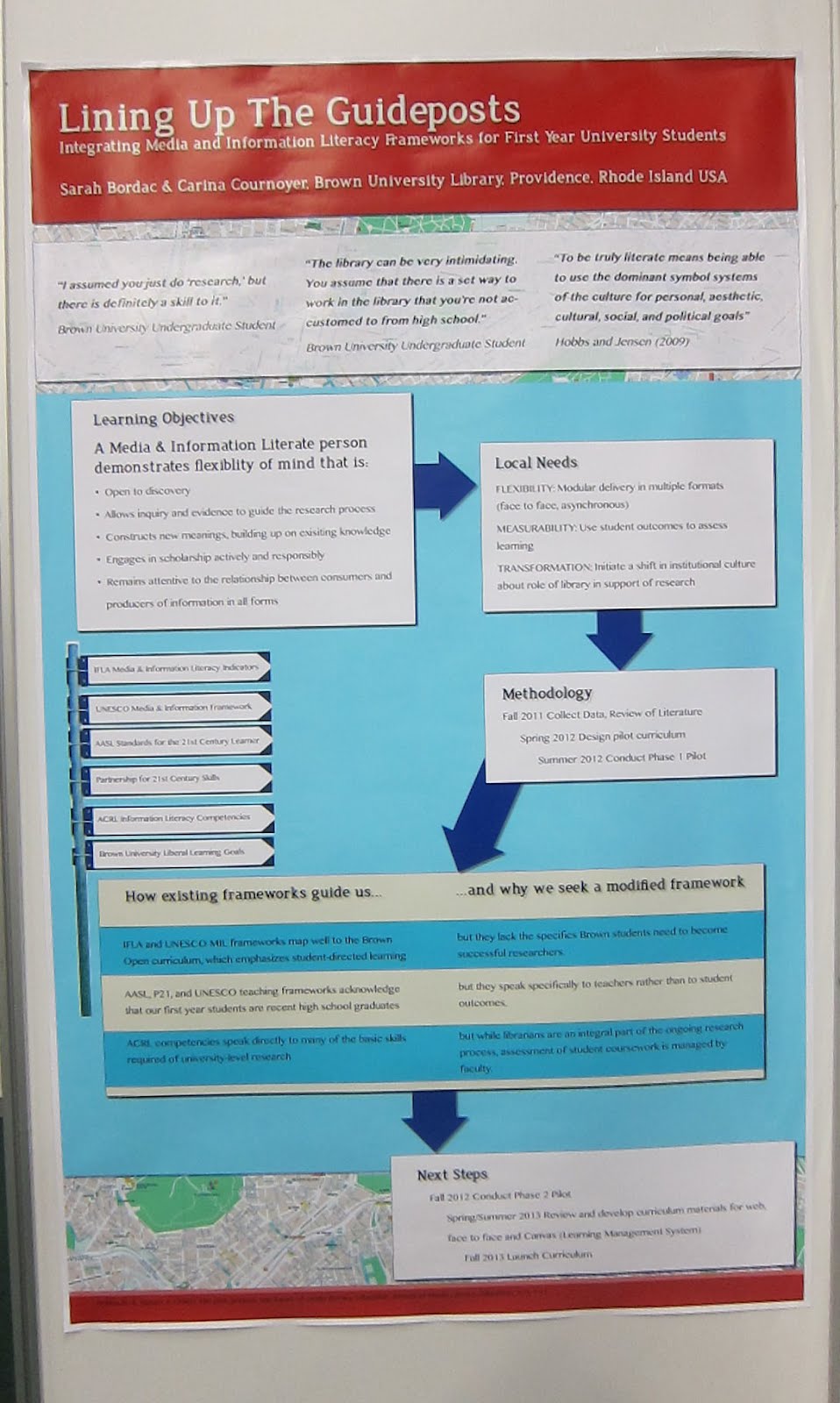
Secondly, a poster by Sarah Bordac and Carina Cournoyer of Brown University, USA: Lining up the guideposts: integrating media and information literacy frameworks for first year university students. They have examined a range of existing standards and frameworks (as listed on the poster), and found that none of them gave exactly what they wanted. However they have drawn on them to develop their own framework, and are currently at the pilot stage.

I found a libguide on searching at Brown by Sarah Bordac here: http://libguides.brown.edu/research and you may also be interested in a list of resources drawn up by an intern at Brown University.

Tuesday, August 7, 2012

Student retention ACRL discussion

The ACRL Student Retention Discussion Group is discussing the article: Emmons, M. and Wilkinson, M. (2011) "The Academic Library Impact on Student Persistence". College and Research Libraries, 72 (2), 128-149. http://crl.acrl.org/content/72/2/128.full.pdf+html
The discussion takes place throughout August. You can read the comments by visiting the page, and can also join the discussion if you sign up to ALA Connect (free, you don't have to be an ALA member): go to http://connect.ala.org/node/184729
Photo by Sheila Webber: My front door, August 2012

Friday, June 22, 2012

New report on "evolving value for academic libraries"

Creaser, C and Spezi, V. (2012) Working together: evolving value for academic libraries. Sage. This newly-published report is the outcome of a project for Sage (the publishers) undertaken by LISU at Loughborough University, UK. The report is fairly short (16 pages). The findings are based on investigating some "best practice" at 8 universities: 2 in Nordic countries, 2 in the UK and 4 in North America, plus a questionnaire which was publicised via discussion lists etc. and got 630 responses. There are short sections on "embedding information literacy", "integrated teaching", "other support services", and "integrated research services". There is also a chapter on marketing issues. Recommendations are made for individual librarians (including developing teaching skills), library managers, and the wider institution. I'm not sure there is anything startlingly new here, but the report and the examples it gives could be useful when planning or putting together a case about services. The report is free (you have to give your contact details before downloading the report), downloaded from the "Report" tab on the project blog at http://libraryvalue.wordpress.com/
Photo by Sheila Webber: poppies, by the Sheffield tram stop, June 2012

Friday, May 18, 2012

Reference Services Review: twittering

There's a Twitter focus in the latest issue (vol 40 no 2) of Reference Services Review:
- Libraries atwitter: trends in academic library tweeting: by Darcy Del Bosque, Sam A. Leif, Susie Skarl (pp. 199 - 213)
- To tweet, or not to tweet? by Susan Jennings (pp. 214 - 216)
- Students tweet the darndest things about your library – and why you need to listen. by Steven Bell (pp. 217 - 220)
- Just the right tweet at just the right time. by Ameet Doshi (pp. 221 - 223)
- Beyond broadcasting: Customer service, community and information experience in the Twittersphere. by Lyndelle Gunton, Kate Davis (pp. 224 - 227)
Other articles include:
- Reference Services Review: content analysis, 2006-2011: by Katy Mahraj (pp. 182 - 198) This analysis confirms that the vast majority of authors are from the academic sector, with 83% from the United States, and "information literacy and instruction" is the topic with the biggest share of articles.
- Information literacy on Facebook: an analysis. by Donna Witek, Teresa Grettano (pp. 242 - 257)
- Student preference for tutorial design: a usability study. by Lori S. Mestre (pp. 258 - 276)
- Engaging undergraduates in discipline-based research. by Heidi Gauder, Fred Jenkins (pp. 277 - 294)
This is a priced publication: here is the home page: http://www.emeraldinsight.com/journals.htm?issn=0090-7324
Photo by Sheila Webber: York castle with bluebells, 2012

Wednesday, April 25, 2012

Survey on professional development needs

A survey is underway on behalf of ACRL’s Instruction Section [Association of College and Research Libraries, USA], to look at the continuing professional development needs of librarians engaging in teaching online, i.e. "any means of teaching through the web including online research guides, tutorials, online chat reference, asynchronous online classes, and synchronous online classes. The questions are not limited to librarians whose primary job responsibilities include online instruction, but to any librarian who participates in online instruction in any capacity. Findings may influence ACRL Instruction Section’s support of professional development in this area and will be presented at the 2012 ALA Annual meeting in Anaheim, CA." The survey of 12 questions is at http://svy.mk/HVWxwV The deadline is May 11 2012 and you can contact alael2012c@gmail.com with any questions.
Photo by Sheila Webber: My cherry blossom, April 2012.

Wednesday, February 15, 2012

Latest issue of Reference Services Review

Reference Services Review, Volume 40 issue 1, 2012. Articles include:
Demystifying the data interview: Developing a foundation for reference librarians to talk with researchers about their data: Jake Carlson
Training Millennials: a practical and theoretical approach: Kathleen Langan Video lectures help enhance online information literacy course: Ed Hahn
Research skills development through collaborative virtual learning environments: Adrian Stagg, Lindy Kimmins
Digital games in academic libraries: a review of games and suggested best practices: Mary J. Snyder Broussard
Empowered library eLearning: Capturing assessment and reporting with ease, efficiency, and effectiveness: George Germek
Still a mixed bag: A study of first-year composition students' internet citations at the University of Mississippi:Alex P. Watson
Incorporation and visibility of reference and social networking tools on ARL member libraries' websites: Leila June Rod-Welch
This is a priced publication: home page at http://www.emeraldinsight.com/journals.htm?issn=0090-7324
Image created from words on the issue home page, using http://www.tagxedo.com/

Monday, February 13, 2012

Arcadia project reports

I have blogged about the recent information literacy currculum project which was part of the Arcadia Programme, but I don't think I have highlighted some of the other outcomes from the prammes. There are still some reports to be published, Student reading in theory and practise by Oszkar Nagy and a report on implementing the information literacy curriculum. As background, "The Arcadia Programme was a three-year programme (2008-2011) funded by a generous grant from the Arcadia Fund to Cambridge University Library. The grant enabled us to explore the role of academic libraries in a digital age, create new programmes and services, particularly for undergraduates -- and also to improve the external environment of the library."
Previous reports/websites include: History uncovered - by Carolyn Keim; Internet Informed Patient symposium website and blogs on the event - by Isla Kuhn; Postgraduate information needs and online tools awareness - by Esther Dingley; IRIS(Induction, Research and Information Skills) - by Lizz Edwards Waller. Go to http://arcadiaproject.lib.cam.ac.uk/publications.html
Photo by Sheila Webber: branch on the icey lake, Sheffield, February 2012

Wednesday, February 1, 2012

Short articles: PBL; Twitter; Discovery tools; QR codes

A new issue of SCONUL Focus (Number 53, 2012) has, as usual, numerous short and readable articles about academic libraries. These include:
- 'Twitter ye not?' by Emma Cragg (aka 'ekcragg') & Antony Brewerton (aka 'librarian boy')
- Focusing on students' discovery tool preferences by Sarah Elsegood
- Introducing problem-based learning into one-shot information literacy instruction at Waterford Institute of Technology Libraries by Alan Carbery & Nora Hegarty
There is also an item by one of the students currently on our MA Librarianship programme, written about the library where he was a trainee: Using QR codes in the library at Leeds Metropolitan University by John Bottomley
http://www.sconul.ac.uk/publications/newsletter/53/
Photo by Sheila Webber: birch and winter sky, January 2012

Monday, January 30, 2012

Video: College Research: What I Wish I Had Known

Evelyn Barker, Instruction and Information Literacy Librarian, at the University of Texas at Arlington, interviewed students to ask them for their advice to people aiming to study at university as regards what "would have better prepared them for college research." She published the resultant video on Youtube in December, entitled College Research: What I Wish I Had Known. The students come up with a lot of sensible advice about managing time, using resources etc.
http://www.youtube.com/watch?v=pzYIXWMhahk