Kim, K., Yoo-Lee, E. and Sin, S. (2011) Social Media as Information Source: Undergraduates’ Use and Evaluation Behavior. In: Proceedings of the 74rd ASIST Annual Meeting Retrieved 18 September 2012 from http://asist.org/asist2011/proceedings/submissions/283_FINAL_SUBMISSION.pdf
An interesting short paper that reports on a survey of what sources students used, what they used them for and what evaluative strategies they used. For example Wikipedia was used for initially scoping a topic, and evaluated through looking at the links and sources, whereas Youtube was used for recreation and for instructions on how to do things, and was evaluated through the video quality and people's opinions.
Markey, K. and Leeder, C. (2011) The Effect of Scoring and Feedback Mechanisms
in an Online Educational Game. In: Proceedings of the 74rd ASIST Annual Meeting. Retrieved 18 September 2012 from http://asist.org/asist2011/proceedings/submissions/38_FINAL_SUBMISSION.docx
This describes the stages of piloting this information literacy game, and the changes that needed to be made as a result.
I discovered these 2 papers (and further interesting ones) as part of the October 2011 ASIST annual conference proceedings; http://asist.org/asist2011/proceedings/openpage.html.
Photo by Sheila Webber: Blackheath Farmers' Market, September 2012
Tuesday, September 18, 2012
LILAC Conference in Manchester in 2013
It has been announced that the LILAC (annual information literacy) conference will take place at the University of Manchester (UK), 25-27 March 2013. The call for papers is not yet open.
Monday, September 17, 2012
The Busy Librarian’s Guide to Information Literacy in Science and Engineering
A new book published by ACRL: The Association of College and Research Libraries:
O'Clair, K. and Davidson, J. (Eds.) (2012) The Busy Librarian’s Guide to Information Literacy in Science and Engineering. ACRL. ISBN-13: 978-0-8389-8619-6
It "provides a practical guide for librarians responsible for science, engineering and/or technology information literacy instruction to understand and apply the ACRL Information Literacy Standards for Science and Engineering/Technology into curriculum design and ongoing instruction". You can get it in print, or as an e-book, or both together. Information is here: http://www.alastore.ala.org/detail.aspx?ID=3999
Photo by Sheila Webber: Ducklings, Blackheath pond, on Sunday (I'm a bit worried about them surviving this time of year!)
O'Clair, K. and Davidson, J. (Eds.) (2012) The Busy Librarian’s Guide to Information Literacy in Science and Engineering. ACRL. ISBN-13: 978-0-8389-8619-6
It "provides a practical guide for librarians responsible for science, engineering and/or technology information literacy instruction to understand and apply the ACRL Information Literacy Standards for Science and Engineering/Technology into curriculum design and ongoing instruction". You can get it in print, or as an e-book, or both together. Information is here: http://www.alastore.ala.org/detail.aspx?ID=3999
Photo by Sheila Webber: Ducklings, Blackheath pond, on Sunday (I'm a bit worried about them surviving this time of year!)
Journal club in SL: 19 September (designing a tutorial)
What: Journal Club, led by Sheila Webber (i.e. me), Sheffield University iSchool (Sheila Yoshikawa in Second Life (SL). Every month we have a discussion about a selected article; all are welcome, just turn up; you need a SL avatar and the SL browser installed on your computer.
When: 19 Sept, 12 noon to 1pm Second Life time (which is the same as US Pacific time; 8pm-9pm UK time, see http://tinyurl.com/9kozv4f for times elsewhere)
Where: Journal club room, Infolit iSchool, in the virtual world Second Life http://slurl.com/secondlife/Infolit%20iSchool/106/208/30/ (That takes you to a map, you click Teleport to activate the SL browser)
Paper for discussion (about developing and use testing a tutorial on academic integrity, at Aukland University):
Wang, L. (2012) "Designing an interactive virtual learning environment (VLE) with a learner centered approach." In: IFLA World Library and Information Conference 2012: Helsinki August 2012: Programme proceedings. Available from
http://conference.ifla.org/sites/default/files/files/papers/wlic2012/93-wang-en.pdf
There will be a 10 minute introduction to the paper in voice and then a discussion in text chat. Potential discussion questions include:
- what kinds of user-testing have you done with tutorials?
- have you encountered the same responses/ issues as the author?
- have you used similar tools and colleagues when developing tutorials?
A Sheffield iSchool Centre for Information Literacy Research Event
When: 19 Sept, 12 noon to 1pm Second Life time (which is the same as US Pacific time; 8pm-9pm UK time, see http://tinyurl.com/9kozv4f for times elsewhere)
Where: Journal club room, Infolit iSchool, in the virtual world Second Life http://slurl.com/secondlife/Infolit%20iSchool/106/208/30/ (That takes you to a map, you click Teleport to activate the SL browser)
Paper for discussion (about developing and use testing a tutorial on academic integrity, at Aukland University):
Wang, L. (2012) "Designing an interactive virtual learning environment (VLE) with a learner centered approach." In: IFLA World Library and Information Conference 2012: Helsinki August 2012: Programme proceedings. Available from
http://conference.ifla.org/sites/default/files/files/papers/wlic2012/93-wang-en.pdf
There will be a 10 minute introduction to the paper in voice and then a discussion in text chat. Potential discussion questions include:
- what kinds of user-testing have you done with tutorials?
- have you encountered the same responses/ issues as the author?
- have you used similar tools and colleagues when developing tutorials?
A Sheffield iSchool Centre for Information Literacy Research Event
Sunday, September 16, 2012
ACRL Student Retention Discussion Group
The September rticle for the ACRL Student Retention Discussion Group is
Blackburn, H. (2010) "Shhh! No talking about retention in the library!" Education libraries, 33 (1), 24-30. http://www.eric.ed.gov/PDFS/EJ887231.pdf
This is an asynchronous discussion about the article: to join in you need to register at the site (free). Go to http://connect.ala.org/node/186985
Blackburn, H. (2010) "Shhh! No talking about retention in the library!" Education libraries, 33 (1), 24-30. http://www.eric.ed.gov/PDFS/EJ887231.pdf
This is an asynchronous discussion about the article: to join in you need to register at the site (free). Go to http://connect.ala.org/node/186985
Thursday, September 13, 2012
Library 2.012 call for papers - ends tomorrow!
The Library 2.012 virtual conference (to be held October 3 - 5, 2012) call for proposals end tomorrow, 15 September. The conference is free and held online with events to suite different time zones. The broad theme is "the current and future state of libraries. Subject strands include physical and virtual learning spaces, evolving professional roles in today's world, organizing and creating information, changing delivery methods, user-centered access, and mobile and geo-social information environments." There are already a number of accepted proposals about information literacy. http://www.library20.com/page/2-012-conference
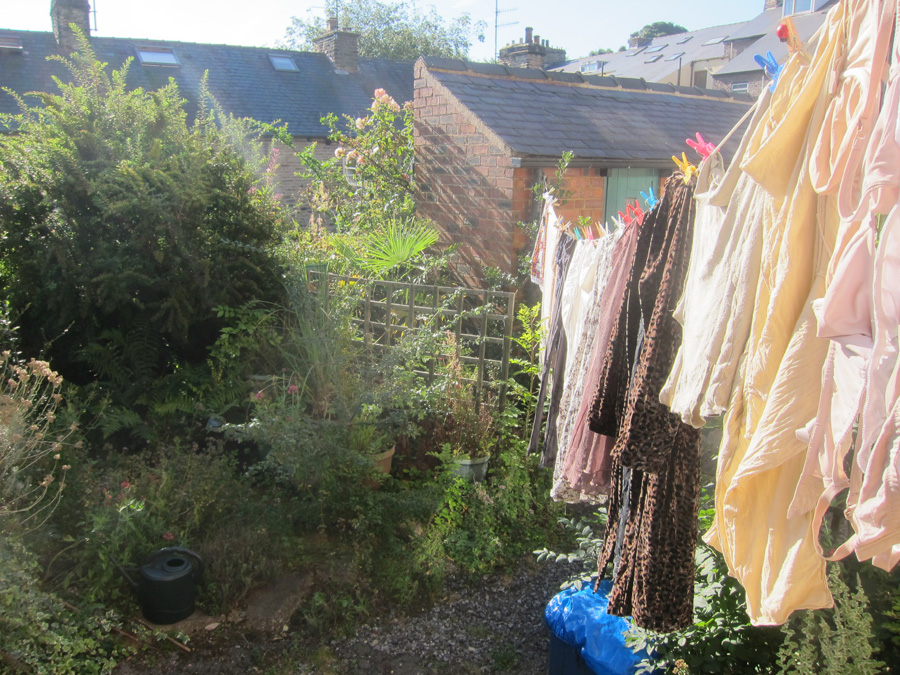
Photo by Sheila Webber: washing on the line in what seems like it was the last of summer, a few days ago
Wednesday, September 12, 2012
Power Searching with Google, free online course
There is an online training course Power Searching with Google running from 24 September to 5 October. It is run by Google themselves, and you can sign up for free. You get "Access to community discussion forum; The opportunity to put your new skills to test with mid and post class assessments; Support from Google course staff; An official Power Searching with Google certificate upon completion" Out of curiosity, I registered, but the dates coincide with the start of the semester, so I may not be able to give it full attention (will be embarrassing if I fail to get my completion certificate ;-) http://www.powersearchingwithgoogle.com/
I found some detailed reflections on the last running of the course on a blog http://sylviamoessinger.wordpress.com/: the author is in Germany but writes in English, and she also has some interesting reflections on a MOOC about e-learning she took, and other aspects of teaching with technology. Her Google-course posts are here: http://sylviamoessinger.wordpress.com/category/google-powersearching/
I discovered the Google course because I was following links to information about Google's "course builder" online educational software https://code.google.com/p/course-builder/ You have to install it on your own server. There is some advice about designing online modules that I would describe as "cheap and cheerful" though it does recommend that you start by spending at least 30 minutes planning the teaching!
Photo by Sheila webber: Poppy, Sheffield Botanic Gardens, September 2012.
I found some detailed reflections on the last running of the course on a blog http://sylviamoessinger.wordpress.com/: the author is in Germany but writes in English, and she also has some interesting reflections on a MOOC about e-learning she took, and other aspects of teaching with technology. Her Google-course posts are here: http://sylviamoessinger.wordpress.com/category/google-powersearching/
I discovered the Google course because I was following links to information about Google's "course builder" online educational software https://code.google.com/p/course-builder/ You have to install it on your own server. There is some advice about designing online modules that I would describe as "cheap and cheerful" though it does recommend that you start by spending at least 30 minutes planning the teaching!
Photo by Sheila webber: Poppy, Sheffield Botanic Gardens, September 2012.
Subscribe to:
Posts (Atom)